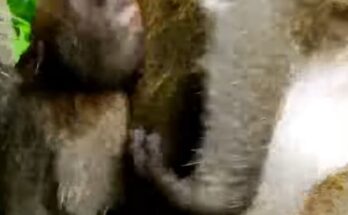
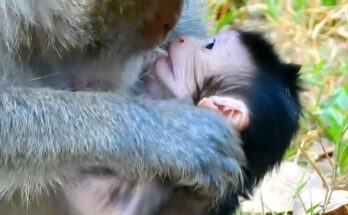
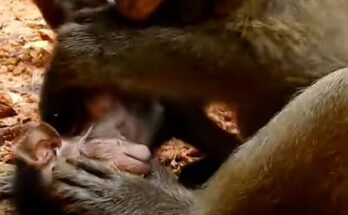
In the heart of a dense jungle, where nature’s rhythm ebbs and flows, a heartbreaking story unfolded this week. A fragile newborn monkey, barely days old, tragically succumbed to injuries sustained after a third accidental fall from the towering canopy. The poignant tale highlights both the challenges of survival in the wild and the fragility of life in its earliest stages.
A Shaky Start to Life
The newborn monkey belonged to a troop of macaques known to inhabit the lush, green expanse of the forest. The troop, typically agile and protective, had recently welcomed the baby into their fold. As the infant clung to its mother’s belly, the world above seemed a precarious place.
For a newborn monkey, survival hinges on the strength of its mother’s grip and its ability to adapt quickly to the constant motion of life in the treetops. However, the mother, possibly young and inexperienced herself, struggled with the coordination and grip required to navigate the perilous canopy while safeguarding her child. This vulnerability became evident in the series of tragic incidents that unfolded.
The First Fall
The first fall occurred just days after the infant’s birth. The mother, attempting to leap between branches, lost her balance. Her grip on the newborn slipped momentarily, and the baby plummeted several feet to a lower branch. Thankfully, the dense foliage broke its fall, and while the baby was visibly shaken, it appeared to survive the ordeal with minimal injuries.
Concerned members of the troop surrounded the mother and infant, seemingly checking on their well-being. Though the baby cried out in distress, the mother’s attempts to soothe it were apparent. The troop’s collective concern reflected the deeply social bonds that define macaque communities.
A Second Close Call
Despite the first incident, the mother continued to care for her infant with unwavering attention. Yet, just a week later, another fall occurred. This time, the baby slipped from the mother’s grasp while she was grooming herself on a narrow branch. The infant tumbled down and hit a rock below, sustaining visible bruises.
Local wildlife observers noted that the baby’s cries were weaker following the second fall, indicating potential internal injuries. Nevertheless, the mother cradled her child and remained close to the troop for protection. The infant’s frailty was becoming more apparent, with its small frame struggling to recover from the repeated trauma.
The Final Fall
The third and final fall occurred two days later. The troop was foraging for food along a steep hillside, with the mother perched precariously on a thin branch. A sudden gust of wind, combined with the slippery surface of the branch, caused her to lose her footing. This time, the baby slipped completely out of her grasp and fell several meters to the ground below.
The impact was devastating. The baby lay motionless, its fragile body unable to endure the trauma of the fall. Members of the troop gathered around the scene, their behaviors exhibiting signs of distress and mourning. The mother’s cries were heart-wrenching as she attempted to rouse her unresponsive infant.
A Reflection on Survival in the Wild
The passing of the newborn monkey serves as a stark reminder of the harsh realities of life in the wild. While the jungle is teeming with beauty and vitality, it is also a place where survival is far from guaranteed, especially for the youngest and most vulnerable.
For primates like macaques, the canopy’s heights are both a sanctuary and a perilous domain. Mothers bear the immense responsibility of ensuring their offspring’s safety while navigating an environment filled with challenges. The loss of this baby underscores the delicate balance required to raise young in such an unforgiving landscape.
Mourning in the Animal Kingdom
Scientists and animal behaviorists have long noted mourning behaviors in primates. The mother’s actions following her baby’s death—from carrying the lifeless body to vocalizing in distress—mirror emotions that humans can deeply empathize with. Such behavior highlights the shared emotional depth between humans and our primate relatives.
The troop’s reaction also suggests a communal understanding of loss. Observers noted that the other macaques stayed close to the grieving mother, offering what appeared to be comfort through physical proximity and gentle touches. Such acts of solidarity reflect the profound social connections that bind primate groups.
A Call for Conservation
While this tragic story unfolded in a protected forest, the challenges faced by wild primates extend beyond natural accidents. Habitat destruction, human-wildlife conflict, and climate change exacerbate the difficulties of survival for many species. Each loss, whether through natural or human-induced causes, serves as a sobering reminder of the importance of conservation efforts.
By safeguarding habitats and raising awareness about the struggles of wildlife, we can honor the lives of creatures like the newborn monkey who never had a chance to thrive. Their stories inspire a deeper appreciation for the resilience of nature and the delicate balance that sustains life on Earth.
In Memory of a Short Life
Though its time was brief, the newborn monkey’s life was not without meaning. Its story has touched the hearts of many who have heard it, reminding us of the fragility and interconnectedness of all living beings. In the dense jungle where it lived and perished, its memory lingers as a poignant symbol of life’s precariousness and the enduring bonds of love and community in the animal kingdom.